Redesign of the vacation structure
in the internal program
Role: Product Designer. Worked in a team with 2 other designers and a product owner
Timeline: 3 months
About the product
WH is an internal time tracking software (similar to Jira) for a company of 90 employees. Over the years of its existence, the product has grown to include: project planning, document management, task cards, and a production calendar.
It is under NDA; illustrations of the solutions can be provided upon request.
Task
The project manager came with a request to redesign the existing vacation section and develop new planning functionality, as the process was clearly not working:
there were constant questions to the HR specialist (how many days are left, can I postpone my vacation, can I take a day off, what is the status of my application),
employees took more/less than they were supposed to or violated the intervals between vacations,
not all employees fully understood the procedure for planning and approving vacations,
interchangeable colleagues went on vacation at the same time (project activities).
Limitations
multiple levels of approval for vacations, so it was necessary to be able to change dates during the approval process, and not just at the start.
the balance calculation had to take into account northern coefficients and days off,
and not just the standard vacation allowance.the company's activities are mainly project-based, so conflicts had to be checked not only by departments, but also by the employee's involvement in specific projects: if work on a project was scheduled for the selected dates, the system should mark the vacation
on those dates as risky.it was impossible to heavily restructure the logic of the entire product, the solution was integrated
into the existing system.
Research

Solutions
Before: planning without context.
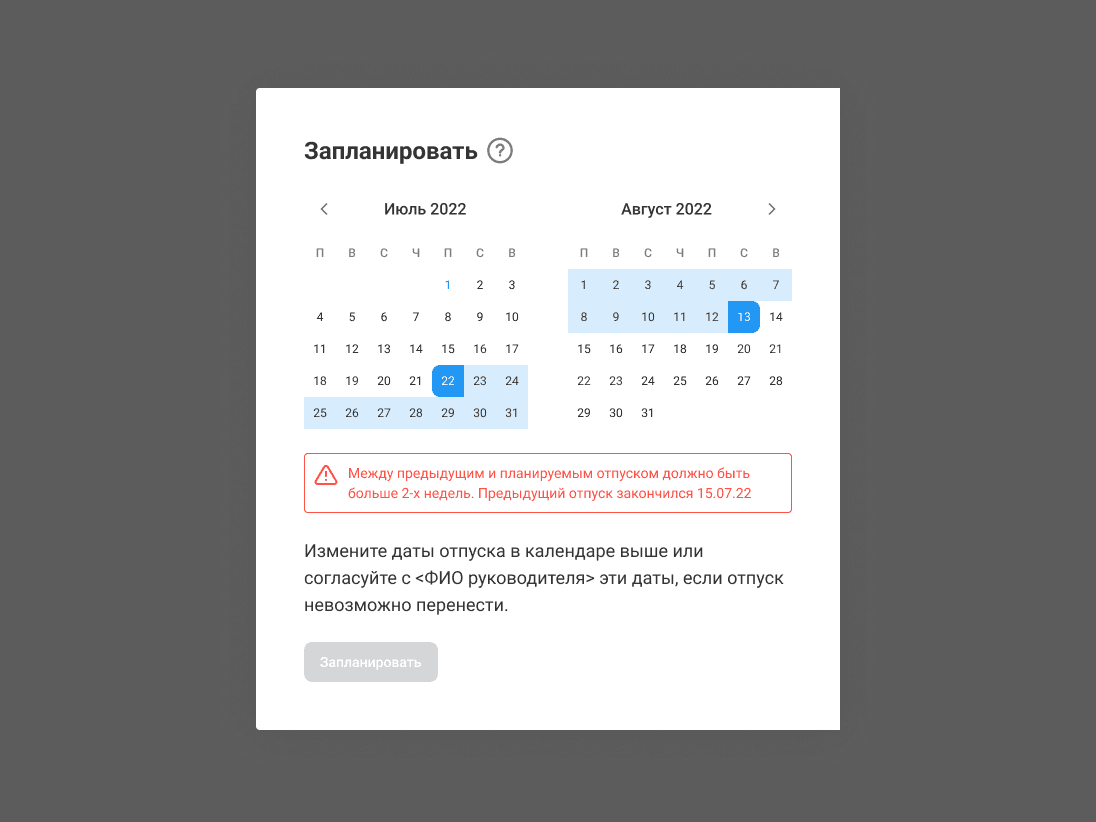
After: smart hints when choosing dates (overlaps with colleagues, minimum intervals, remaining days). Justified by the fact that 80% chose dates blindly, and 17 out of 20 in the test expected exactly this system behavior.
Before: manual search for conflicts.
Now: automatic highlighting of intersections with colleagues. Justified by the fact that 5 out of 7 managers found out about the conflict only after submitting the application, which is too late to change anything without rework.
Before: it was unknown how many days were left.
Now: the vacation balance is visible immediately in the interface. This is justified by the fact that it was one of the questions that the HR specialist heard every day.
Before: it was unclear what was happening with the application.
Now: application history with approval statuses. Justified by the fact that 85% in the usability test did not see the problem with the application until it went for approval, meaning the status was opaque throughout the process.
Before: the HR specialist answered repetitive questions.
After: all the necessary information is available in the interface. A direct consequence of the interview with the HR specialist.